
Department of EYE BANK
Home » Our Services » EYE BANK
Who We Are
Our eye bank is one of the biggest, busiest and most well equipped in North India, with the latest state-of the-art equipment. SCEH Eye Bank is registered under the Transplantation of Human organ Act (THOA) 1994 (42 of 1994), Government of India and we are a lifetime member of Eye Bank Association of India (EBAI). Our dedicated team of professionals are committed to restoring hope and vision for patients suffering from corneal dieases like infections, opacities, degenerations and dystrophies, trauma, and Keratoconus. We conduct evaluations and investigations to ensure high quality corneal tissue for transplantation, research and education. We are equipped with latest technology and unwavering compassion to honor the legacy of the donors and emperor the recipients to regain vision.
For guidance and support on eye donation, reach us at 8860610666 email us at donateeyes@sceh.net
EYE BANK Transplants DATA FOR YEAR 2025
vision:
To become a world leader in eye banking andcorneal transplantation, setting the higheststandards of quality and innovation.
One Donation, A Lifetime of Light
We often understand the value of sight only when it is lost. Around 1.1 million people, many of them young adults, live without vision. Thankfully, vision lost due to a damaged cornea can be restored through corneal transplantation.
Eye donation and eye banks help make this possible by collecting healthy donor corneas and providing them to trained surgeons, bridging the gap between need and availability.
Mission:
To create a lasting impact on corneal blindness through excellent eye banking, research, and training.
Our Key goals
Increase corneal donation and effective use
Improve the quality and safety of donated tissues
Promote advanced research in eye banking and corneal diseases
Deliver high-quality training & education for eye care professionals
Simple steps for eye donation
For guidance and support on eye donation, reach us at 8860610666 email us at donateeyes@sceh.net
1
How do I contact an eye bank?
the eyes.
2
What is the procedure for eye donation?
Eye donation is a quick and simple process that takes about 15–20 minutes. After being contacted, eye bank team visits the home or hospital, causes no disfigurement, does not delay funeral rites, and ensures the eyes are respectfully closed after the procedure.
3
What precautions are to be taken?
Switch off fans and use an air conditioner if available, Elevate the head with a pillow, Place a clean, wet cloth over closed eyelids, Ensure the eyelids are properly closed, Keep a copy of the death certificate ready, Provide consent and blood samples.
4
Who can donate eyes? Is there any age limit?
Any individual, regardless of age or medical history, can donate eyes, including those who wear spectacles or have undergone cataract surgery.
EYE BANK COLLECTION DATA FOR YEAR 2025
Delhi
1836
Sonipat
346
Alwar
67
Saharanpur
148
GIIMS
12
Amrita
26
Meerut
8
Vrindavan
38
Total
2481
Scope of Services
EYE BANK
Public Awareness
Tissue Harvesting
Tissue Distribution
Tissue Preservation
Pre Cut Tissue Preparation
Amniotic Membrane Processing
Tissue Evaluation
Quality Assurance
Our growth over the years
No Data Found
No Data Found
Our Experts


Commonly asked questions
Eye Donation is an act of charity purely for the benefit of the society and is totally voluntary. Eye Donation is done after death. The Eye donation of the deceased can be authorized by the Next of Kin even if the deceased did not pledge his /her eyes before death.
The Eyes, which are received through such magnanimous gestures, are of great benefit to the society. The front clear and transparent tissue of the eye called Cornea can be used to restore vision to corneal blind persons. The other portions of the eye are also used for training and research purposes to develop cures for some of the common eye diseases.
Corneal blindness occurs when the cornea becomes cloudy, resulting in reduced or lost vision. This can be caused by accidents, infections, industrial incidents, or even malnutrition.
Yes, Removing the damaged Cornea and replacing it with a healthy cornea by surgery can cure corneal blindness.
The cornea be removed from a deceased person within six -eight hours of death and can be used for surgery. The eyes which could ultimately be consigned to flames or buried can restore vision of two patients.
There are 1.1 million people suffering from corneal blindness. Majority of the 1.1 million are young adults who have spend long blind years even though they have a cure.
There are 1.1 million people suffering from corneal blindness. Majority of the 1.1 million are young adults who have spend long blind years even though they have a cure.
To become an eye donor, one should inform their close family members of their intentions. After passing away, family members can contact the nearest eye bank to fulfill the donor’s wishes.
Eye banks, charitable organizations without profit motives, facilitate the removal, processing, evaluation, and distribution of donated eyes to those in need.
Worries about misuse are unfounded as eye banks adhere to strict regulations under the Transplantation of Human Organs Act 1994, and the government regularly inspects them.
Contrary to misconceptions, eye donation is supported by all religions and scriptures, making it a universally endorsed act of compassion.
Hear from Our Patients
A Ray of Hope: Mrs. Chandawati’s Journey to Restored Vision
At 70 years of age, Mrs Chandawati, a resident of Sita Ram Bazar, Delhi-6, began facing a series of troubling vision problems that disrupted her daily life. For over six months, she endured persistent dizziness, severe headaches, and gradually diminishing eyesight that made even the simplest of tasks difficult. Visits to local clinics and repeated treatments brought her little relief — until she arrived at Dr. Shroff’s Charity Eye Hospital, a place that would soon transform her life.
Read More
At the hospital, she met Mr. Siddharth, whose compassion and commitment left a lasting impression on her. Upon evaluation, the doctors diagnosed a serious issue with her cornea, requiring immediate surgical intervention. However, the cost of the surgery initially felt beyond her reach. Seeing her distress, Siddharth Sir stepped forward, ensuring that financial limitations would not stand in the way of her recovery. Through the hospital’s charitable support and the assistance of the Koshika Foundation, Mrs. Chandawati was able to undergo the much-needed surgery — completely free of cost.
The operation was a success. Within days, her vision began to return, and with it, her confidence and joy. The dizziness and headaches faded, replaced by gratitude and renewed hope. Today, she speaks of her experience with emotion — her eyes shining with clarity, both literally and figuratively.
“I had lost all hope,” she says softly. “But Dr Shroff’s Hospital, and the Koshika Foundation gave me back my sight — and my life. I can see again, and for that, I will always be thankful.”
Mrs Chandawati’s story is not just one of medical recovery — it is a powerful reminder of how empathy, expertise, and community support can come together to change lives. Through initiatives like these, Dr Shroff’s Charity Eye Hospital and Koshika Foundation continue to bring light to those living in darkness, one patient at a time.
Prachi’s Gift of Sight: Illuminating Hope and Love
Every parent’s worst nightmare is to face the heart-wrenching loss of their child. Such was the tragic fate of Prachi, a vibrant and beautiful 14-year-old girl who unexpectedly suffered a massive cardiac arrest while getting ready for school on December 19, 2022. Despite the desperate efforts of her parents, Prachi was pronounced dead at the hospital.
Read More
In the face of unimaginable grief, the family found solace in an act of incredible kindness. The SCEH Eye Bank’s compassionate counselor reached out to Prachi’s father, Mr. Pradeep Kumar, to discuss the possibility of eye donation. They explained how this selfless gesture could give the gift of sight to two individuals suffering from corneal blindness. Moved by the opportunity to honor his daughter’s memory and bring hope to others, Mr. Pradeep Kumar decided to proceed with the eye donation.
The trained team of the Eye Bank carefully procured Prachi’s corneas, and upon examination, they were found to be in excellent condition. The very next morning, two families received life-changing news. Two young children, who had been anxiously waiting for suitable corneal matches for months, were finally going to undergo successful PK surgeries. Thanks to the brave and compassionate decision taken by Prachi’s family, these two kids now had a fighting chance at living normal lives once again.
Though the pain of losing their beloved daughter was profound, Prachi’s legacy lived on through the priceless gift she gave to those in need. Her corneas brought light and vision back into the lives of two children, proving that even in the darkest moments, acts of kindness can illuminate the world with hope and love.
Achievements and Awards
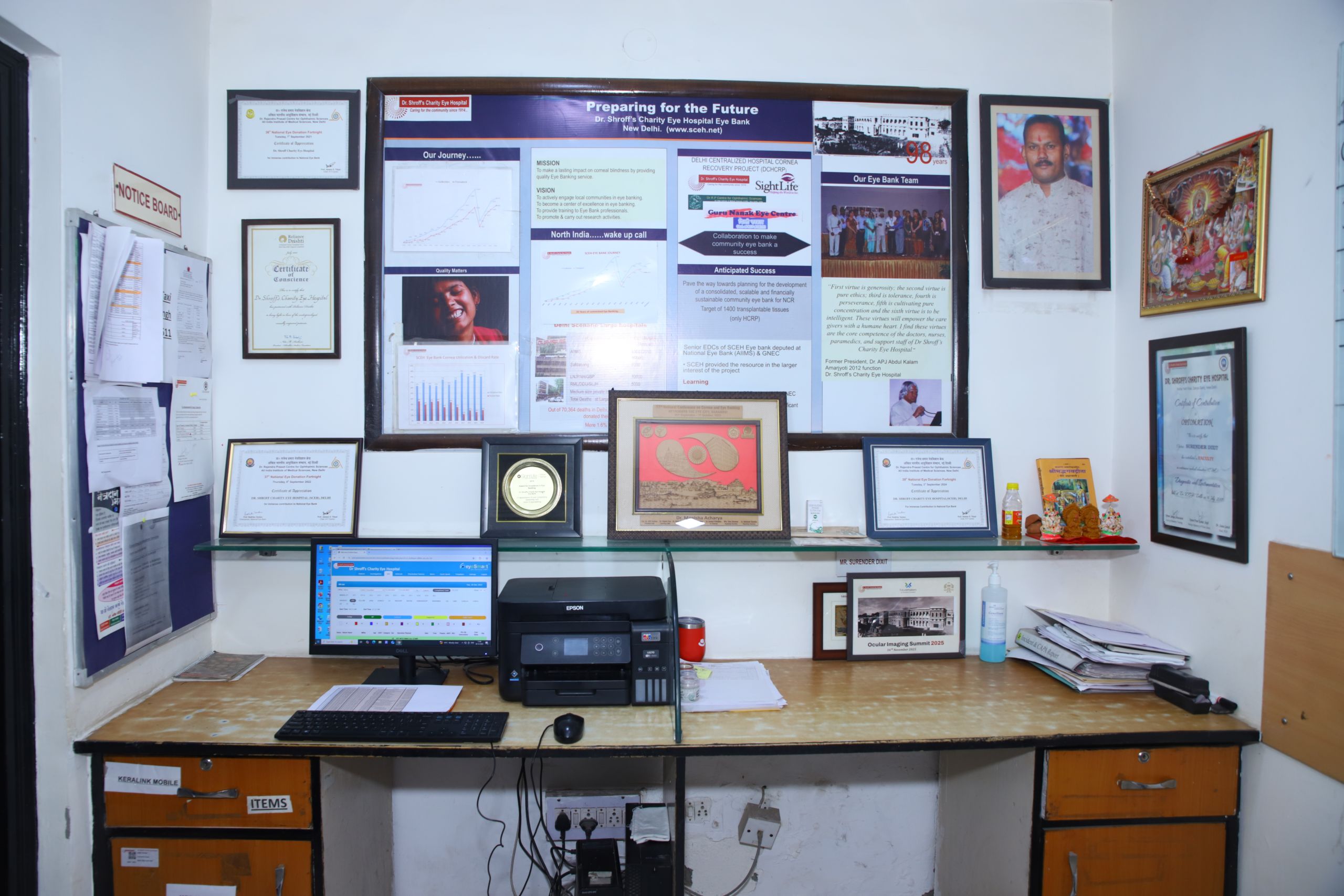
We are accredited by NABH and affiliated with EBAI
Recipient of 2016 BMJ South Asia Quality Improvement award
Recipient of 2022 A P Sah Rolling Trophy for the Best Practice Eye Bank in north India by Eye Bank Association of India (EBAI)
FAQ's for Eye Donation

Eye Donation is an act of charity purely for the benefit of the society and is totally voluntary. Eye Donation is done after death. The Eye donation of the deceased can be authorized by the Next of Kin even if the deceased did not pledge his /her eyes before death.
The Eyes, which are received through such magnanimous gestures, are of great benefit to the society. The front clear and transparent tissue of the eye called Cornea can be used to restore vision to corneal blind persons. The other portions of the eye are also used for training and research purposes to develop cures for some of the common eye diseases.
The Cornea is the clear tissue covering the front of the eye. Vision will be dramatically reduced or lost if the cornea becomes cloudy. The loss of vision is referred to as corneal blindness.
he Cornea can get damaged through accidents. Children while playing with bows and arrows or sharp objects can accidentally damage their cornea. It can also happen to elders. Some of the industrial causes are chemical burns, flying debris or road accidents. The Cornea can get damaged due to infections and malnutrition also.
Yes, Removing the damaged Cornea and replacing it with a healthy cornea by surgery can cure corneal blindness.
Fortunately cornea can be removed from a deceased person within six -eight hours of death and can be used for surgery. The eyes which could ultimately be consigned to flames or buried can restore vision of two patients.
There are 1.1 million people suffering from corneal blindness. Majority of the 1.1 million are young adults who have spend long blind years even though they have a cure.
Eyes are removed only after death. A person wishing to donate eyes should make close family members aware of their intentions. After the death of the person it is the family members who can inform the family members who can inform the nearest eye bank to fulfill the wishes of the deceased are authorize removal of the eyes if somebody from an eye bank approaches the family.
An Eye Bank is a charitable organization without any profit motive. They are purely functioning for the benefit of the society. The eye banks facilitate removal of eyes, processing of eyes and evaluation of the eyes and distribute them to the needy.
Eye Banks are covered under Transplantation of Human Organs Act 1994. It is a criminal offense to buy or sell organs. The Government issues certificates of registration to eye banks and has a provision to inspect them regularly. In case a complaint is filed against any eye bank, the government can take legal action.
A special number 1919 (BSNL) has been allotted for eye banks. Most of the eye banks all over the country have this number. Once information for eye donation is given here, the eye bank sends its team to collect the eyes. By calling this number details about eye donation can also be had.
Call 1919 or the local telephone directory usually lists the phone number of eye banks under essential services. The eye bank personnel would give directions and precautions to be taken. The process of removing eyes does not take more than 15 to 20 minutes. The eye bank team can come either go to the house where death has taken place or to the hospital where death happened and remove the eyes there. It would not delay funeral arrangements.
Switch off fans and switch on Air Conditioner ( if available) Raise the head with the pillow. Place wet clean cloth over the closed eyelids. Please ensure that the eyelids are properly closed. Keep a copy of the death certificate ready. The eye bank team which would have a trained technician or a registered medical practitioner would remove the eyes after taking consent on a printed from and also take a blood sample.
There are two methods adopted for removal of eyes. Some eye banks would remove the whole eyeball. The eye bank team after removal of eyes would properly close the eyes after putting the artificial eye so there is no disfigurement. The second method is removal of only the clear transparent tissue. Here also a plastic shield is placed in place of the tissue and no difference can be noticed.
All religions endorse eye donation. There are numerous examples in our traditions and scriptures which endorse eye and organ donation. A part of the body which would be consumed by flames and reduced to ashes or which is buried and allowed to decay and disintegrate cannot be put to a better use than restoring vision to the needy!!
Anybody of any age can donate eyes. Even if the deceased has medical history of hypertension, diabetes, asthma, tuberculosis etc.
Even spectacle wearers and people who have undergone cataract operation can donate eyes.
Eye bank Publications
Nathawat R, Farooqui JH, Majumdar A, Acharya M. Indian J Ophthalmol. 2024 Jan 1;72(1):76-80. doi: 10.4103/IJO.IJO_2031_23. Epub 2023 Dec 22. PMID: 38131574; PMCID: PMC10841774.
Acharya M, Biswas S, Das A, Dave A, Mathur U. Indian J Ophthalmol. 2021 Feb;69(2):391-394. doi: 10.4103/ijo.IJO_2617_20
Salz AK, Acharya M, Hofmann N, Wittmershaus I, Sangwan V, Börgel M, Mathur U. Indian J Ophthalmol. 2021 Jun;69(6):1592-1597. doi: 10.4103/ijo.IJO_3249_20.
Farooqui JH, Acharya M, Schunder I, Hinesley R, Das A. Indian J Ophthalmol. 2020 Jun;68(6):1037-1039. doi: 10.4103/ijo.IJO_1482_19
Acharya M, Biswas S, Das A, Dave A, Mathur U. J Curr Ophthalmol. 2019 Aug 2;31(4):387-393. doi: 10.1016/j.joco.2019.07.001. eCollection 2019 Dec.
Dave A, Patel NV, Acharya M, Chaku D, Das A, Mathur U, Biswas S.Int Ophthalmol. 2019 Nov 25. doi: 10.1007/s10792-019-01225-2.
Acharya M, Farooqui JH, Dave A, Chaku D, Ganguly KK, Das A, Mathur U. Indian J Ophthalmol. 2019 Oct;67(10):1570-1574. doi: 10.4103/ijo.IJO_2151_18.
Farooqui JH, Acharya M, Dave A, Chaku D, Das A, Mathur U. J Curr Ophthalmol. 2018 Dec 7;31(2):218-219. doi: 10.1016/j.joco.2018.11.001.
Acharya M, Farooqui JH, Mathur U. Indian J Ophthalmol. 2018 Aug;66(8):1225-1227. doi: 10.4103/ijo.IJO_357_18..
Acharya M, Biswas S, Das A, Mathur U, Dave A, Singh A, Dubey S. Indian J Ophthalmol. 2018 Mar;66(3):389-393. doi: 10.4103/ijo.IJO_861_17.
Kapur N, Gunda S, Dixit S, Chauhan L, Acharya M, Mathur U. Indian J Ophthalmol. 2018 Feb;66(2):219-222. doi: 10.4103/ijo.IJO_677_17
Acharya M, Chaku D, Dave A, Das A, Patel NV. Cornea. 2018 Jan;37(1):e2-e3. doi: 10.1097/ICO.0000000000001372. – LTE
Acharya M, Dave A, Verma B, Chaku D, Das A, Patel NV. Cornea. 2017 Oct;36(10):e28. doi: 10.1097/ICO.0000000000001312.- LTE
SCEH Eye Bank’s network:
- Delhi – call 8860610666
- Vrindavan – call 6397888895
- Meerut - call 6397576258
- Sonipat – call 7015887210
- Alwar – call 8005882558
Recipient of 2016 BMJ South Asia Quality Improvement award